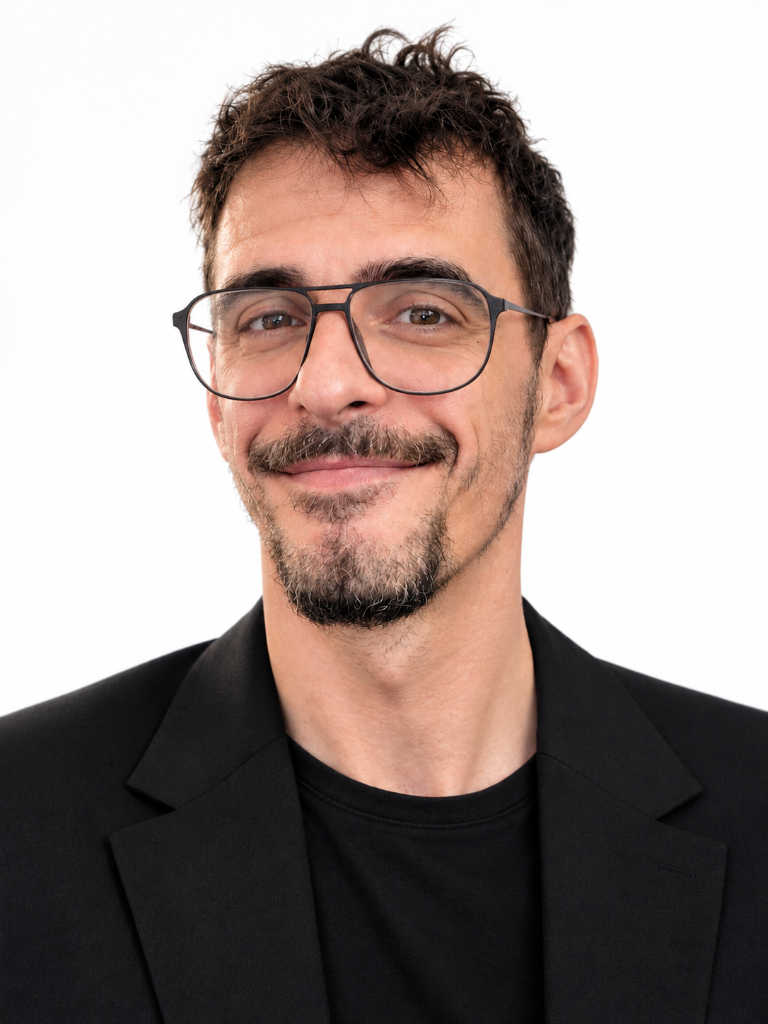
I am a translator and I am deaf.
From a psychological standpoint, this might actually be a somewhat suspicious profession. You spend your life listening to or watching other people, and then trying to figure out what they actually meant.
Yet the interesting question is rarely: What was said?
What's much more interesting is: What is supposed to be understood?
Maybe that's exactly what fascinated me about translating.
I don’t just translate words. I convey content in a way that makes it sound natural, is easily understood, and retains its impact in another language. Especially when it comes to videos, corporate content, and marketing texts, it’s important for me to consider not only the text itself, but also the context, the target audience, and the message.
That's harder than it sounds.
At first glance, translating seems quite simple.
In practice, however, there’s much more to it than that.
After all, as we all know, people don’t always say what they mean. Sometimes they even say exactly what they mean—and yet still mean something else. That’s probably one of the reasons we invented psychologists… and translators.
My approach to language is therefore a visual one. As a deaf person, I perceive communication differently. Not worse, not better—just differently.
I pay attention to the elements that are often left out of written language: facial expressions, body language, space, movement, and everything that happens between the words. In sign languages, these elements are not merely a supplement to language, but an integral part of it.
That's exactly where translation begins for me.
A good translation shouldn't look like a translation. It shouldn't come across as a visitor who still has his coat on. It should walk in, take a seat, and act as if it had always been there.
This applies to written languages as well as to sign languages.
And then there's the issue of accessibility.
By that, I don't mean making everything as simple as possible. On the contrary. To me, accessibility means not constantly forcing people to adapt to a world that wasn't designed with them in mind.
Communication should work.
For everyone.
Perhaps, in the end, this is also the most personal description of my work: I’m interested in people and in how they connect with one another. I’m interested in language because it connects us—and occasionally leads to some pretty serious misunderstandings.
Between perfection and what really matters
When I look at one of my early translations today, I sometimes have to smile. Not out of a sense of superiority—human memory is far too unreliable for that—but because such examples are a wonderful way to see what experience does to a person. Back then, my approach was different, times were different, and my attitude toward my own abilities was probably still a bit… more optimistic. Today I know this: You never truly become a fully-fledged translator. At best, you get better at recognizing what you don’t yet know. Freud would probably have seen this as a nice piece of evidence for the unconscious.
That’s why perfection isn’t my goal. It’s a strange concept anyway: You can produce a perfectly correct translation and still completely miss the mark with the reader. What matters most to me is that the message gets across—with its meaning, its tone, and, if possible, its own little human life. To achieve that, it sometimes takes a surprising amount of time before the actual translation even begins. For me, a good preliminary discussion isn’t just a bureaucratic formality—it’s already part of the translation process: What is the context? What is the actual point being made? What absolutely must not be lost? And above all: Who is on the other end?
After all, sometimes a translator's most important contribution isn't having the right answer right away, but asking the right question first.